Features of Oligopoly Easy Entry and Exit
There are many oligopoly examples in today's society. In fact, the device you are using now may very well be part of an oligopoly. With that said, it is important to realise that an oligopoly is generally defined by its market concentration. In other words, a few firms control the market. Let us look at some examples below:
In the US, the top 6 firms account for close to 90 percent of the mass media market: Walt Disney (DIS), Time Warner (TWX), CBS Corporation (CBS), Viacom (VIAB), NBC Universal, and News Corporation (NWSA).
Collectively, all of: Ford, Chrysler, General Motors, and Toyota; have a collective market share of close to 60 percent in the US.
Apple, Samsung, and Huawei own a combined market share of over 50 percent of the entire global market.
Combined, Kellogg's, General Mills, Post, and Quaker own over 85 percent of the US cereal market.
Anheuser-Busch InBev, SABMiller, Heineken International, and Carlsberg Group own over 70 percent of the global beer market.
The top four firms: Verizon (VZ), Sprint (S), AT&T (T), and T-Mobile (TMUS); own a combined 98 percent of the total US wireless network market.
The top 4 firms: Universal Music Group, Sony, BMG, Warner, and EMI Group; control close to 90 percent of the US market.
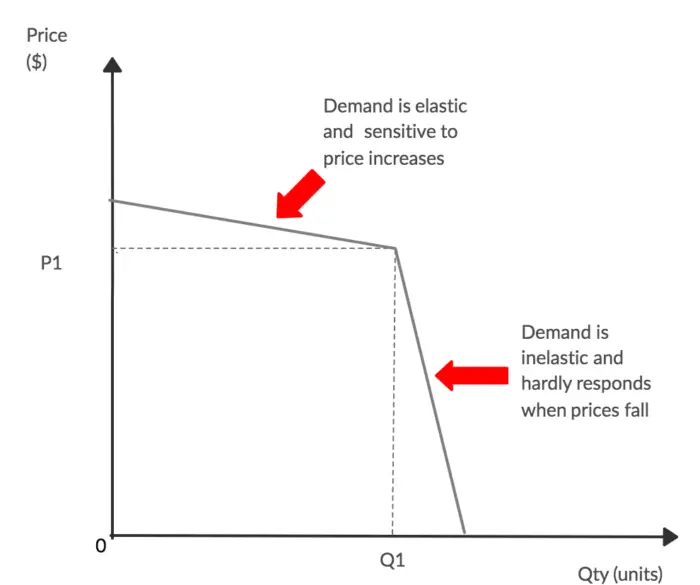
The kinked demand curve is distinctive of an oligopolistic market. It shows how, at higher and lower prices, the elasticity of demand changes. As a result, prices remain relatively rigid.
Copyright: Boycewire
As we can we in the chart above, firms are unlikely to be incentivised to increase or decrease prices.
This is because increasing prices will significantly impact demand. As competitors keep their prices stable, the firm that increases prices will lose customers to cheaper rivals.
At the same time, reducing prices won't increase demand. This is because price decreases will be met with fierce competition. In an oligopoly, when one firm reduces its prices, the others follow. In turn, any real gains in demand will be negligible.
Now let us take an example of how this works:
| Your Business | Competitor | Result |
|---|---|---|
| You Increase Prices P ↑ | Competitors ignore and keep prices their prices the same P = | Elastic demand. Demand is highly sensitive to price, so a lot of your customers will go to the cheaper competitors. |
| You Decrease Prices P ↓ | Competitors follow suit and reduce their prices | Inelastic demand. As all other competitors follow, demand for your products hardly changes |
The concentration ratio comes in a number of forms: third-firm ratio, four-firm ratio, five-firm ratio, and six-firm ratio. From this, the concentration ratio calculates the market share of the top 3 to 6 firms in the market.
Let us take the automobile industry in the US as an example. If we are to do a four-firm ratio, we would take the leading four companies: General Motors, Toyota, Ford, and Chrysler. Then, we work out their combined market share:
| General Motors: | 17 percent |
| Toyota: | 14.6 percent |
| Ford: | 14.4 percent |
| Chrysler: | 13 percent |
| Total: | 59 percent |
|---|
So according to the four-firm ratio, the automobile industries has a concentration of 59 percent. In turn, we can define this as an oligopoly. This is because for a four-firm ratio; anything over 50 percent could be considered an oligopoly. Similarly, for a five-firm ratio; anything over 60 percent could also be considered an oligopoly.
The Herfindahl-Hirschman Index is a method by which we can tell how concentrated a market is. Most commonly, it is used by the US Department of Justice to consider when to take action in anti-competitive markets.
Quite simply, anything under a score of 1,500 is considered as a competitive marketplace. Anything between a HHI score of 1,500 and 2,500 is considered moderately competitive. And anything over 2,500 is extremely concentrated. For markets with a score of over 1,500; they would classify as an oligopoly, all the way up to 10,000 – which signals a monopoly.
The HHI is calculated by selecting each firm's market share. The market share is then squared individually, with the results added together. This can be seen below:
HHI = Business1 ² + Business2 ² + Business3 ² + BusinessN ²
So let us now take an example.
- Business 1 Market Share = 30 percent
- Business 2 Market Share = 20 percent
- Business 3 Market Share = 15 percent
- Business 4 Market Share = 10 percent
The HHI is then calculated as: HHI = 30² + 20² + 15² + 10² = 900 + 400 + 225 + 100 = HHI 1625.
What is an example of an oligopoly?
Cellular Networks
The top four firms in the US: Verizon (VZ), Sprint (S), AT&T (T), and T-Mobile (TMUS); own a combined 98 percent of the total wireless network market.
What are the characteristics of an oligopoly?
1. A Few Firms with Large Market Share
2. High Barriers to Entry
3. Interdependence
4. Each Firm Has Little Market Power In Its Own Right
5. Higher Prices than Perfect Competition
6. More Efficient
Is Apple an oligopoly?
In the mobile phone market, Apple is part of an oligopoly. To take a case in point, Apple, Samsung, and Huawei own a combined market share of over 50 percent of the entire global market.
Is Coca Cola an oligopoly?
Coca-Cola is an oligopoly in the fact that the firm itself owns other brands such as Fanta. The only real competitor of any significance is Pepsi, which owns other brands such as Tango. In turn, both Pepsi and Coca-Cola own the majority of the soft drinks market, therefore qualifying as an oligopoly.
Source: https://boycewire.com/oligopoly-definition/
0 Response to "Features of Oligopoly Easy Entry and Exit"
Post a Comment